

I neatly fold my wonton skin in half to form a triangle before bending the far corners towards each other like a fortune cookie and sealing the join with a dab of water. It’s a perfect diamond shape.
My mum, on the other hand, plops the pork mince in the middle and simply bunches all the edges together in one swift motion, like a moneybag dumpling. She thinks I waste my time with all the folding business, and her method is much more efficient.
I think my way is better, obviously, because it’s the traditional way.
Where did I learn this ‘traditional and better way?’, you might ask. None other than Australian-Japanese cookbook sensation Nagi Maehashi. And why did I suddenly decide to go against the grain of generations of my family’s method of making our favourite comfort dish? I suspect it was my narrow assumption that Nagi’s popularity makes her methods gospel and somehow ‘official’ in my eyes – so when Nagi wears army pants and flip flops, I wear army pants and flip flops.
There’s a certain irony in these folds, where the student thinks they have become the master. My mum grew up in an all-Chinese household, where both her Chinese immigrant parents cooked at home and passed those skills on to each of their six children. They all fold wontons like their parents.
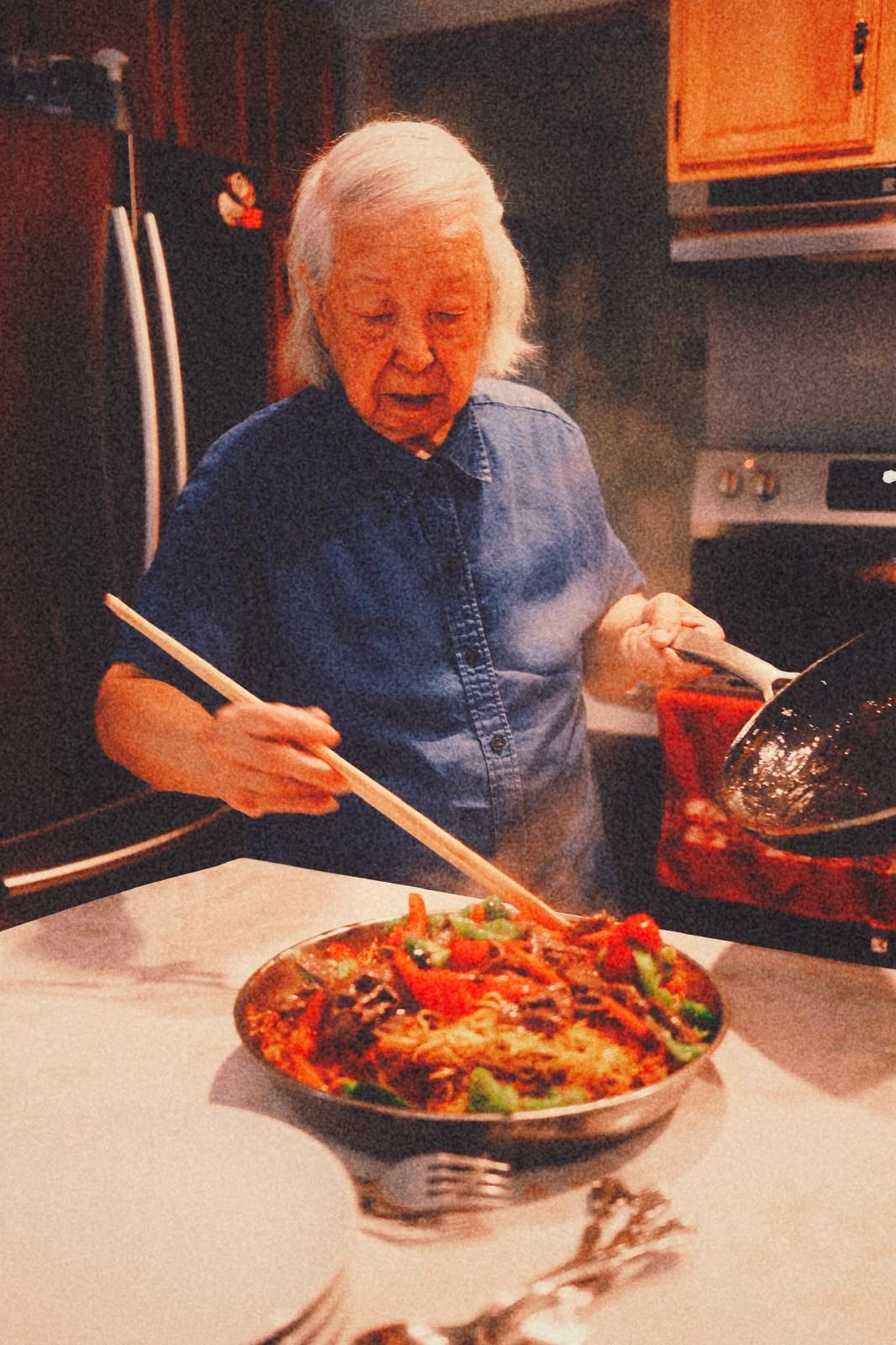
When authenticity looks like a wonton
In truth, I think part of me feels as if folding wontons in the ‘proper way’ affirms my membership to and compensates for my diluted ethnic background as a half-Chinese, half-Australian person. The irony, of course, being I took that ‘proper’ method from Nagi, not my actual Chinese family.
Being mixed race is a strange thing to explain to people: how it feels to be on a constant quest for authenticity and cultural validation from both sides.
Being mixed race is a strange thing to explain to people: how it feels to be on a constant quest for authenticity and cultural validation from both sides. Growing up in Melbourne, there was no shortage of Australian influence in my life, but my lack of connection to family in China and not understanding the language can sometimes make me feel inadequate – not Chinese enough. Food is the one thing I understand well and it ties me to my cultural background.
As I’ve grown older and learned to cook for myself, this connection has only deepened. We never ate Sunday roasts in my house growing up; it was more like Sunday chow mein with leftovers for the next four days. If we're hosting guests with finger foods, it’s Peking duck wraps, char siu sou and potstickers. When I’m sick and want some comfort food, it’s spicy Sichuan wonton soup for the soul.
So despite the fact that I am arguably Asian fusion myself I feel a smug and obnoxious sense of obligation to point out my understanding of real Chinese food.
I stand on my little pedestal and say that I much prefer the Chinese food prepared by my mum and my maternal grandmother, Poh Poh in Cantonese, to anything I’ve tried in a restaurant. Maybe it’s my subconscious thirst for authenticity, maybe it’s the seasoning of nostalgia in every bite, or maybe it’s because I am not spending $8 per piece for a microwaved frozen dumpling with some soy sauce and spring onions on it in a trendy neon light-lined, industrial-chic restaurant.
I think, in the same way, I have an internalised agenda to prove my Chinese-ness through my cooking and appreciation of food, Australians’ palates are diversifying, as if they too have a point to prove about how multicultural they are when it comes to cuisine choices. Nobody gets aura points for liking dishes such as butter chicken or fried rice anymore, and of course, half the country has found themselves in Japan in the last five years. These days, it feels like the dishes that once drew the biggest grimaces are now the trendiest bites.
Looking for the ‘proper’ way to belong
In primary school and high school, the closest I got to bringing Chinese food in for lunch was instant noodle cups. Despite what I was eating at home, I knew that this dish was playground currency’s highest bargaining chip and that is pretty much all that matters to an 11-year-old. An enviable lunch was like an express train to the cool club, and I wasn’t about to miss the stop because I was busy microwaving some yum cha leftovers from the weekend. Ironically, my instant noodles were ‘Oriental’ flavoured.
But ‘the times they are a-changin’’. Last month, I brought leftover boiled wontons in spicy Sichuan garlic and chilli oil to work, and you’d best believe those aromas infiltrated the entire microwave and kitchen. Now you might be thinking, ‘Who in their right mind brings in pungent food to the work kitchen?’ I know – it’s against the unspoken code of respectable, healthy and scent-free lunches – cue the Kardashian salad shake. Turns out, it’s my colleagues. Unfortunately for the olfactorily gifted, we have a daily rotation of tuna cans, boiled eggs and off milk in the fridge that nobody has claimed. So really, by comparison, my wontons were a drop in the ocean.
I can’t help but wonder if this is the age of smelly food supremacy. I hope so.
And as it turns out, people want a piece of that drop. Instead of the echoing ‘ews’ associated with the primary school ethnic vs cool lunch hierarchy, I had people asking me for the recipe. It’s Nagi, of course.
I can’t help but wonder if this is the age of smelly food supremacy. I hope so.
Who gets to call food authentic
It’s somewhat telling of the lunch hierarchy that still exists in our society, that it’s white Australians who call the shots on when an ethnic dish goes from foreign and weird to eye-opening and trendy. On a personal level, I feel like a bit of a fraud that the pride in my heritage and my culture’s food is only validated by others who’ve now decided it’s cool. But that’s the thing about being a halfie… I suppose the white people are my people too.
I suppose what I’ve learnt from all of this is that it doesn’t really matter how we fold our wontons. Nor is it about the filling or the way it’s served. The reason I love the dish so much isn’t just because it’s tasty, and it has nothing to do with the fact that I’m Chinese. It’s because wontons come with so many sentimental memories of enjoying them and making them with my family. Everybody has memories like this, that tie food to memories and experiences. Some people’s experiences are learning to fold wontons as a child around the kitchen bench, and some are paying the eight-dollar special at an inner-city foodie joint over equally overpriced wines with friends. At the end of the day, being able to share these memories and connections with each other’s culture is a privilege, no matter our ethnic background.
Plus, who am I to say that a bit of love from white people dilutes authenticity?


