

For most people under 40, Facebook is a graveyard of two-toned MacBook selfies and AI slop. An echo chamber of high school peers’ babies at best and racist family members at worst. Useful for little beyond finding a sharehouse or remembering a birthday.
But for a community of home cooks, it’s also a form of guerrilla marketing that sidesteps the rules of running a hospo business. No permits, no inspections, no real oversight – just home kitchens, plastic containers and a Messenger thread. It opens food service to more people, but also sits in a legal grey zone that most buyers are happy not to think about.
You’ll find it on Marketplace, past the used mattresses and sagging couches – a whole world of edibles hidden in plain sight. The scene’s taken off in the States, where Facebook food vlogs pull millions of views and picking up dinner from the boot of a stranger’s car is the least of your worries.
In Australia, with stricter food safety laws, limited street food culture and a general wariness of people outside our immediate circles, the scene feels smaller. But it exists, with migrant and diaspora communities at the forefront.
A search within an 8 km radius of the CBD turns up Nepalese momos, trays of Filipino pancit, pandan layer cake and Greek Easter bread. Listings flick between English and native languages, sometimes both, aimed at people looking for something closer to home than what restaurants usually offer.
Opening a shop comes with obvious barriers – rent, staff, compliance, commercial kitchens. Cooking at home is simpler. List it online for free and suddenly you’ve got a low-stakes business. Low-stakes for the seller, at least. As a buyer, I could see the worst-case scenarios: food poisoning, actual poisoning, even kidnapping.
Still, I’d been eyeing the Marketplace food space for a while. Homemade samosas and garden-grown produce had been on my mind, and this felt like the perfect excuse to dive in. I abide by the five-second (plus) rule. I believe germs are good for immunity. I see risk as character-building, to my parents’ dismay.
If anyone was going to do this for the sake of food journalism, it might as well be me.
Test 1: The Thali
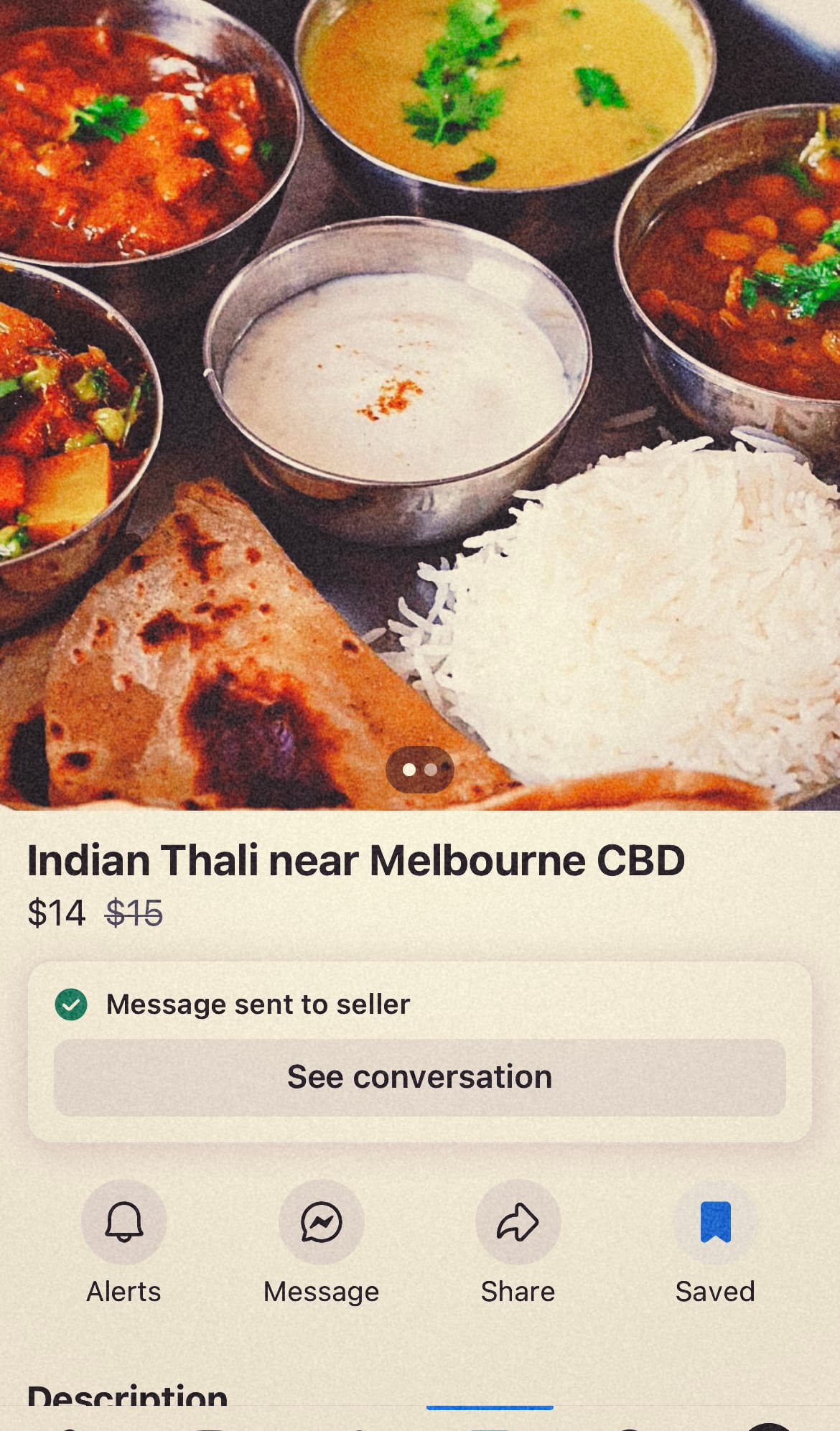
Most Marketplace food is concentrated in Truganina or Keysborough, Mernda or Roxburgh Park – suburbs I know by name but not by experience. As an overcommitted, non-driving city dweller, I needed something that didn’t require an hour on public transport. Proximity was part of the appeal: seeing how easily this parallel food system could slot into my life if I knew how to tap into it. Then, by some miracle, I found a thali in Southbank.
My enquiry got me a quick, friendly offer to pick up that day if I wanted. The daily fish special was tempting, but I had dinner plans, so we locked something in for later that week. A few questions followed – chicken or meatless, rice or roti, one veg or two – landing me a three-dish thali for $16, cheaper than most Uber Eats meals.
I met the vendor at a tram stop on St Kilda Road near his apartment. Turns out he was handling pickup for his wife, who did the cooking. Business had been strong, he said – a few regulars, some ordering several times a week. He asked if I’d had Indian food before. ‘Of course,’ I said, ‘I love it,’ which earned a smile and an upsell of curries by the container.
He handed over the thali – a hefty spread in a compostable container, wrapped in plastic. I peeled it back and got hit with a wave of spice, enough to stop me opening it on the tram, but the second I got home, all bets were off.
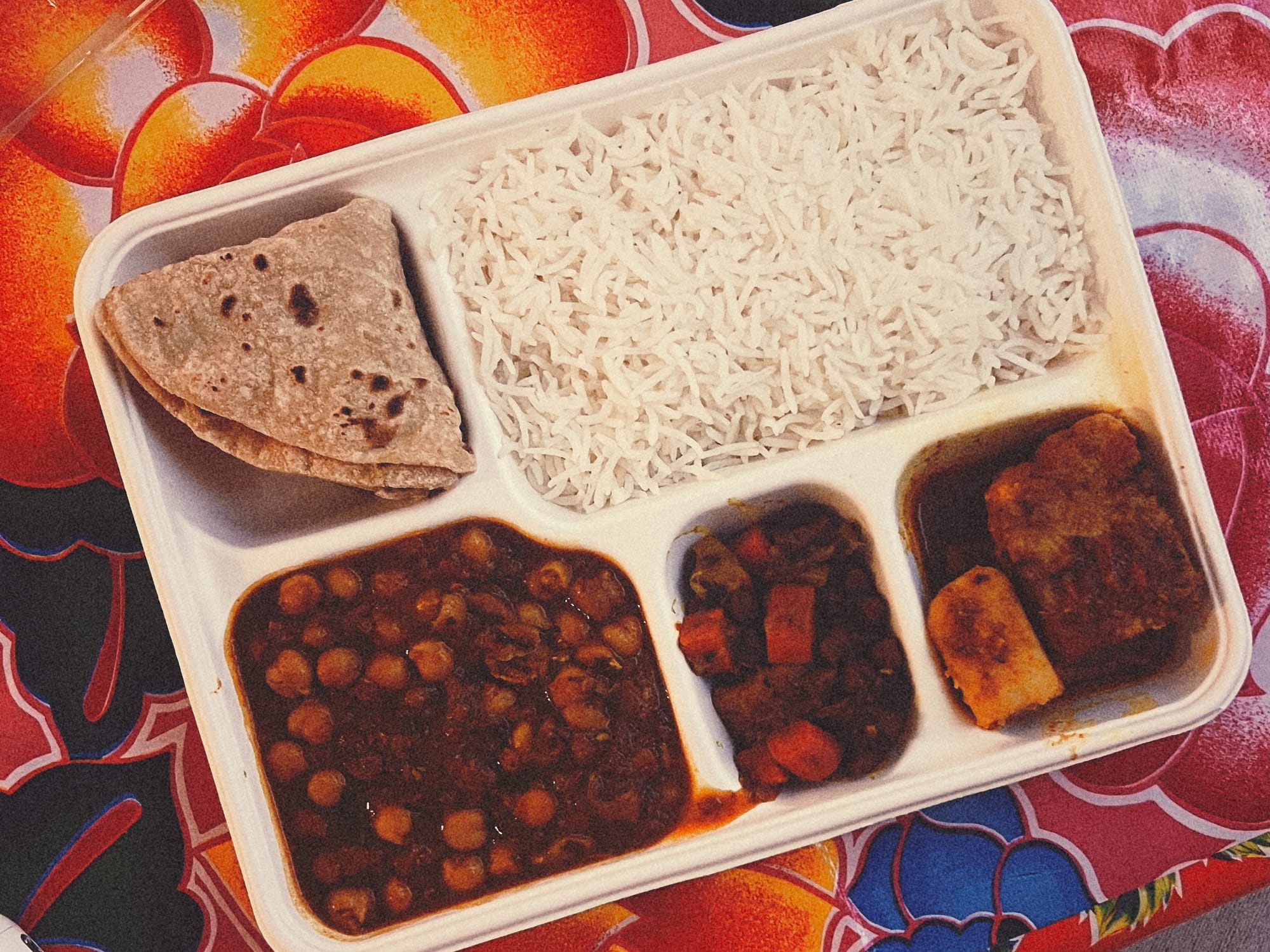
Chickpeas first, hotter than the whitewashed versions I’m often served at Indian restaurants here. Then an equally punchy veg cutlet, a trio of black chickpeas, carrot and squash, rice and two fluffy housemade roti. The spread stretched across multiple meals and I didn’t get food poisoning. One for one.


