

‘Excuse me, are you guys halal?’
It’s the last resort after spending a few minutes scanning the walls for a halal certificate, and scouring Google with the trusty ‘[restaurant name] Sydney halal’.
A simple question. One that induces my fight-or-flight response. I hope they know what halal means. I hope they can answer without calling over another colleague. Or, God forbid, they bring the chef into this.
The stock-standard response here is a puzzled look. I repeat myself, skimming through every possible pronunciation ‘Hay-lal? Is your meat hah-lal? Ha-laawhl?’
I repeat myself, skimming through every possible pronunciation ‘Hay-lal? Is your meat hah-lal? Ha-laawhl?’
The irony here is the popularisation of the halal snack pack (HSP). It’s practically an Australian institution on par with the chicken parma. And yet people still don’t know what halal means.
‘Bible Belt’ to Auburn
Living in the ‘Bible Belt’, home never came easily for Muslims like myself. It’s not that I hate the Hills Shire or that I feel unwelcome, quite the opposite. It’s fine. And that’s exactly the problem.
Fine is not the same as belonging. My postcode was never anything deeper than muscle memory. Home always felt distant, something I might find elsewhere, and somewhere that wasn’t in Sydney. That is, until I found myself on the T2 line to Auburn, a suburb I once knew only through headlines, crime statistics, and the look people give you when you say ‘Auburn’.
On the T2 line to Auburn, a suburb I once knew only through headlines, crime statistics, and the look people give you when you say ‘Auburn’.
Stepping out of Auburn station, I was greeted with a row of overseas currency exchange shops decorated with flashing LED boards. Immigration lawyers next to fruit shops next to tobacconists next to kebab joints and gold shops. The streets were alive in a way I didn’t know I was craving. Lost and curious, I pulled out my phone and navigated to South Parade.
Caffeine, concrete, mosque
Auburn didn’t try so hard, and I loved that. What began as a one-off commute quickly became a ritual. For six months, I drove to and from Auburn on my weekends for a Muslim Leadership Program I’d enrolled in.
Oliver Brown became a safe haven. Early-morning coffees before training sessions, late-night hot chocolates after long days. (This is my sincere apology to the staff that mopped their way around us after closing time).
The Auburn Central car park saved me before the price hike. It also became the bane of my existence, particularly when my car was locked in and I had to call my dad to drive all the way to Auburn at midnight to pick me up after an evening at Vivid Sydney.
The first time I walked into Gallipoli Mosque, it was quiet in a way I wasn’t used to. Not exactly silence, more like white noise: the murmur of the automatic fans, the soft thud of children playing on the plush carpet. My friend and I were kicked out more than once for lingering too long, unaware the mosque closed after prayer times during the year. During Ramadan, we returned for taraweeh prayers, listening to sermons delivered in Turkish; neither of us was Turkish, nor did we understand the language – yet somehow it never mattered. We kept coming back.
How do I keep ending up here?
When the program ended, I no longer had anything tying me to Auburn. My visits slowed to the occasional family lunch at Jasmin1 Restaurant. As my dad manoeuvred the car into one of four impossibly tight parking spots, we’d enter the comforting chaos of Jasmin1 racing to secure a table before a suspiciously young waiter took our order.
Auburn returned to my weekly rhythm when we moved my Jido (grandfather) to Gallipoli Homes. This time around, it wasn’t just mine – it was ours. On the surface, Saturdays are mundane. Grocery shopping. Errands. Spending hours in the car. But ritual has a way of becoming memory before you realise it. Pre-emptive nostalgia.
We pick up my Tete (grandmother) in Castle Hill, crawl through Saturday traffic and arrive at Gallipoli Homes. We park in the C-shaped driveway. My dad steps out and heads upstairs to help my Jido get ready. In the car are me, my mum and my Tete. I shuffle into the middle seat, and I find myself sandwiched between three generations, between strength and softness, between stories I’ve inherited and the ones I’m still learning.
Turkish breakfast for my Jido, an almond croissant and lactose-free cappuccino for Tete, the rest of us rotating in and out of the sticky food court table as if it belongs to us.
A few hours at Lidcombe shops follow – Turkish breakfast for my Jido, an almond croissant and lactose-free cappuccino for Tete, the rest of us rotating in and out of the sticky food court table as if it belongs to us. On the walk back, we stop at Fruitopia to grab fresh fruit for Jido, and an ode to my inner child as I grab an eccentric snack that I frantically bring to my dad as he approaches the counter. Then it’s off to Gima supermarket, where my mum and Tete spend 15 minutes debating which new frozen pastry to try out, and the employees speak to me in Turkish without question.
Unbothered
This is all to say: in Auburn, I do not perform. I live. No need to soften my name, my faith, my family. On these streets, men switch effortlessly between English and another language as they lean against shopfront windows. Women move with familiarity through aisles and mosques and cafes. Children sprawl, elders linger, life unfolds without spectacle.
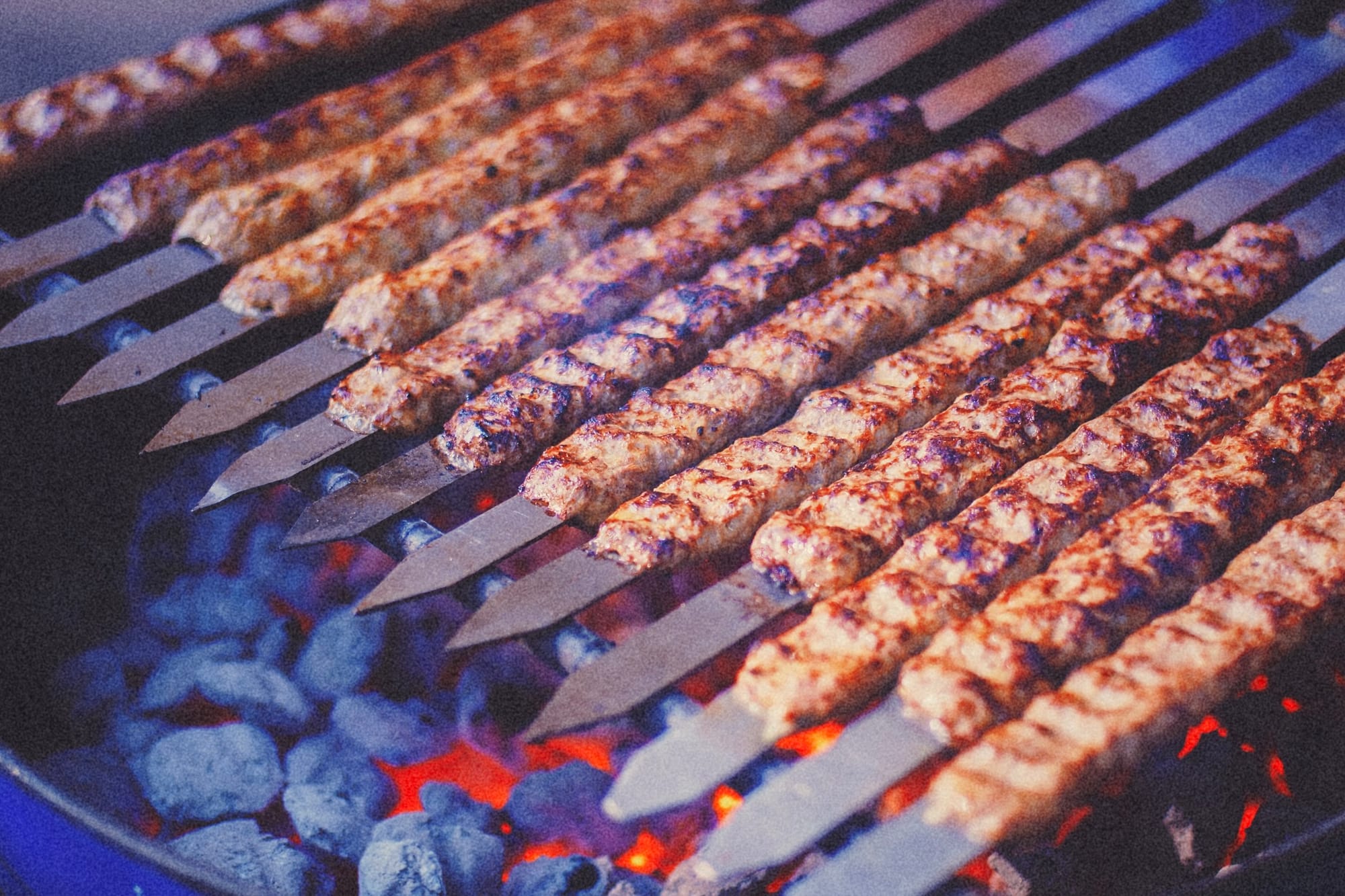
The kebab shop owner stares at me blankly when I ask if they’re halal – not because they don’t understand, but because it is a given.
Auburn feels like home, not because it tries to be anything more than it is, but because here, nothing needs to be asked.


